
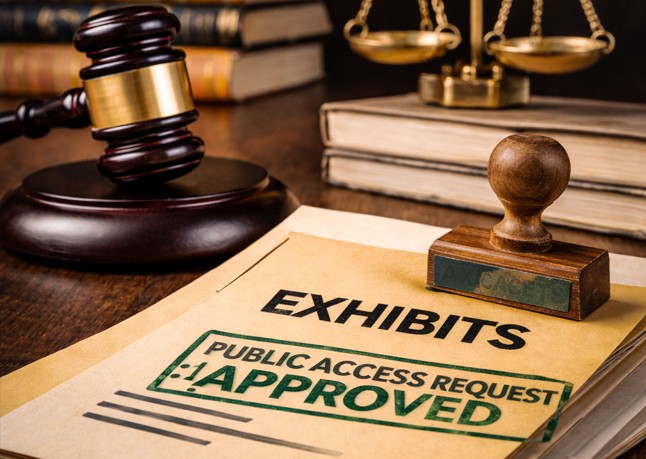
In a recent decision, the New Jersey Appellate Division reaffirmed the State’s strong commitment to transparency in judicial proceedings—holding that evidentiary exhibits used in open court remain subject to public access, even if they have been returned to the party who introduced them.
In In the Matter of the Application of JB Nicholas, Docket Nos. A-2265-23 and A-2266-23 (App. Div. Feb. 2, 2026), a journalist sought copies of fifteen exhibits admitted during a criminal pretrial detention hearing in Passaic County. The clerk’s office denied the request, explaining that the exhibits had been returned to the Prosecutor’s Office under Rule 1:2-3 and were no longer in the Judiciary’s possession. The trial court also denied the journalist’s motion to intervene in the criminal matter for the limited purpose of obtaining the exhibits.
The Appellate Division reversed both decisions.
Exhibits Are Court Records
The court emphasized that Rule 1:38 broadly defines “court records” to include evidentiary exhibits. The fact that exhibits were returned to the offering party did not remove them from public access. The Appellate Division harmonized Rule 1:2-3 (which allows courts to return exhibits) with Rule 1:38 (which mandates open access), holding that courts retain control over exhibits and may direct their return when a public records request is made.
The court cautioned that interpreting the rules otherwise would create a loophole—allowing parties to avoid public access simply by retrieving exhibits after a hearing.
Openness Is the Default
The decision reinforces several key principles:
- New Jersey recognizes both a common law and First Amendment right of access to judicial proceedings and records.
- Court records are presumptively open unless a specific rule or sealing order applies.
- Any limitation must be narrowly tailored. Redaction—not wholesale denial—is the preferred remedy.
- The burden is on the party seeking to block access.
- Access should be provided expeditiously.
Because the pretrial detention hearing was not sealed and no finding of confidentiality had been made, the court ordered that the exhibits be produced promptly, subject only to limited redactions if legally required.
Practical Impact
For attorneys and litigants, this case is an important reminder: materials introduced in open court generally remain accessible to the public—even after the proceeding concludes.
For journalists and members of the public, the ruling confirms that New Jersey’s judiciary maintains a strong “open access” policy and that procedural technicalities cannot be used to defeat transparency.
Why It Matters
The Appellate Division ultimately reversed and remanded with direction that the requester be given immediate access to the exhibits—underscoring that transparency in the courts is not optional, but foundational to public confidence in the justice system.
If you have questions about public access to court records or need assistance navigating the Open Public Records Act (OPRA), our firm’s OPRA attorney, Walter M. Luers, has extensive experience handling OPRA matters for both attorneys and clients. He regularly advises on access disputes, exemptions, and litigation involving public records, and he is available to assist with strategic guidance and enforcement when access is improperly denied.